The Waiter's API: Node.js CRUD for Chefs & Customers
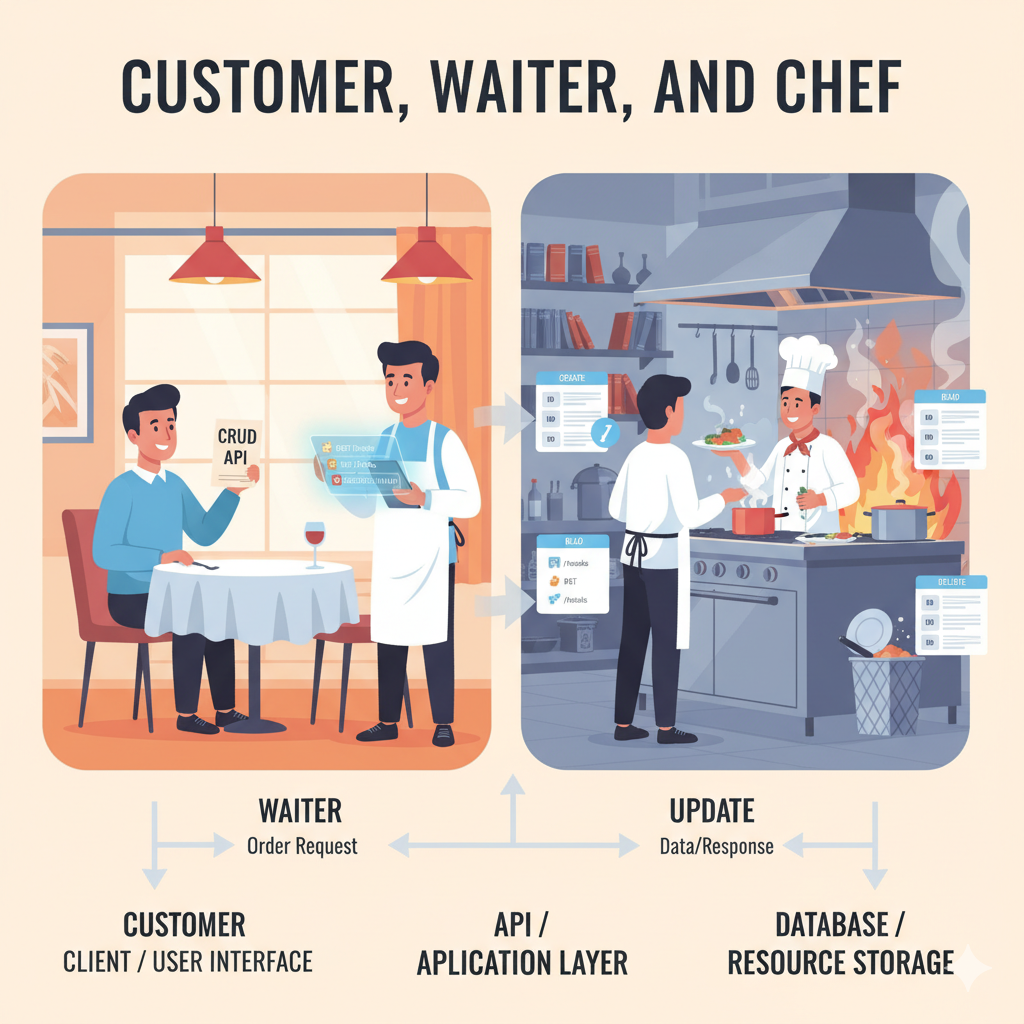
The Analogy: Customer, Waiter, and Chef API
Imagine you're at a restaurant, eager to enjoy a meal. The process of ordering and receiving your food is a great way to understand how an API works.
1. The Customer (The Client/User Interface) Who they are: You, sitting at the table, deciding what you want to eat. You don't know (or care) how the food is cooked, what ingredients are in the kitchen, or the chef's secret recipes. Their role in API: The client application or user interface. This could be your web browser, a mobile app, or even another server. It's the part that needs information or wants to perform an action. Their interaction: The customer (client) makes a request – "I'd like a steak."
2. The Waiter (The API/Application Layer) Who they are: The person who takes your order, brings it to the kitchen, and delivers the food back to you. They are the intermediary. Their role in API: The API (Application Programming Interface) itself, specifically the server-side application layer (e.g., your Node.js/Express app).
The waiter speaks both the customer's language (menu items) and the chef's language (cooking instructions). Their interaction: Receives the customer's request (e.g., an HTTP request like GET /menu/steak or POST /orders with steak details). Understands what the customer wants. Translates that request into specific instructions for the chef. Passes the instructions to the chef. Receives the prepared dish from the chef. Delivers the final product (the data/response) back to the customer.
3. The Chef Cook (The Database/Resource Storage) Who they are: The master of the kitchen, responsible for preparing the food according to the instructions. They manage all the ingredients, cooking equipment, and recipes. Their role in API: The database or resource storage (e.g., MongoDB). This is where the actual data (ingredients) is stored and where the operations (cooking) are performed. The chef only interacts with the waiter, not directly with the customer. Their interaction: Receives precise instructions from the waiter (e.g., "get ingredients for steak," "cook steak medium-rare," "add a new dessert recipe," "remove a dish from the menu"). Accesses ingredients (retrieves data from the database). Performs the requested action (processes the data). Prepares the dish (formats the data). Hands the finished dish (the result of the operation) back to the waiter.